
Can Near-Infrared Light Therapy Help Improve Scar Healing?
Exploring the latest research into photobiomodulation and scar management.
Whether a scar is caused by surgery, an injury or a burn, it can sometimes lead to more than a visible mark. Scars may become painful, itchy, raised or tight, and in some cases they can restrict movement or affect confidence.
Emerging research is examining the role of photobiomodulation (PBM), including red and near-infrared light therapy, as a safe and non-invasive way to support the body’s natural scar-remodelling process.
At Halo Health NI, our Near-Infrared Light Bed is offered as a supportive wellness and recovery therapy. While every scar and healing journey is different, current research suggests that targeted light therapy may have a valuable role alongside standard scar-management treatments.
What Is Photobiomodulation?
Photobiomodulation uses specific wavelengths of red and near-infrared light to stimulate biological processes within the body.
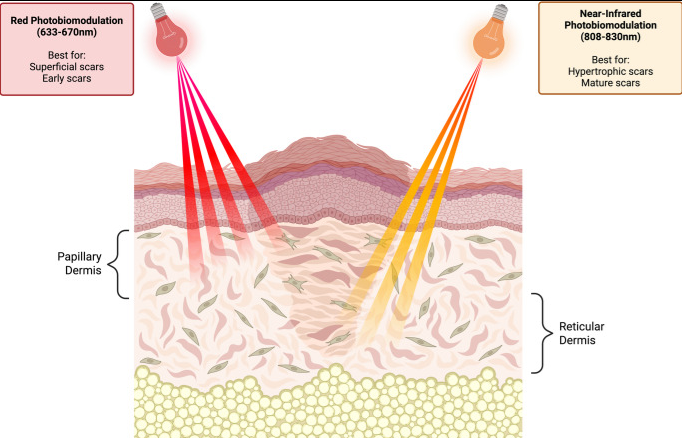
The research reviewed treatments using red light wavelengths between 633 and 670 nanometres, and near-infrared wavelengths between 808 and 830 nanometres.
These wavelengths may be delivered through light-emitting diode, or LED, devices and low-level laser therapy, often referred to as LLLT.
PBM is thought to interact with the mitochondria, which are responsible for producing energy within our cells. By supporting cellular energy production, light therapy may help encourage processes associated with tissue repair and scar remodelling.
Potential biological effects being studied include:
- Supporting healthy tissue repair
- Encouraging collagen remodelling
- Helping to regulate inflammation
- Supporting local circulation
- Improving tissue flexibility and recovery
What Did the Review Examine?
A recent scoping review examined whether red and near-infrared photobiomodulation could improve outcomes in burn scars, hypertrophic scars and post-surgical scars.
Researchers searched PubMed, Embase and MEDLINE for relevant clinical studies published up to October 2025.
Seven randomized or prospective clinical studies met the review criteria, involving a total of 297 participants.
The researchers assessed factors including:
- The type and age of the scar
- The wavelength of light used
- The treatment dose or fluence
- The treatment schedule
- Changes in scar appearance and symptoms
- Any adverse effects
What Did the Research Find?
Although the included studies were relatively small and used different treatment protocols, the results were encouraging across several types of scars.
Burn Scars
Red LED therapy was associated with improvements in burn scars in both children and adults.
Reported benefits included:
- Improved Vancouver Scar Scale scores
- Reduced scar thickness
- Improved pigmentation
- Better overall scar appearance
The review noted that greater improvements were generally seen in scars that were less than 12 months old.
Post-Surgical Scars
Red and near-infrared PBM were also investigated following surgical procedures, including hernia repair, thyroidectomy and blepharoplasty.
Researchers reported improvements in areas such as:
- Scar thickness
- Scar hardness or induration
- Malleability and softness
- Pain
- Itching or pruritus
- Patient and clinician scar-assessment scores
In some post-surgical studies, red LED therapy improved Patient and Observer Scar Assessment Scale, or POSAS, scores.
The research also suggested a biphasic dose response. This means that moderate treatment doses may produce better results than doses that are either too low or too high.
Hypertrophic Scars
Hypertrophic scars are raised, thickened scars that develop when excess collagen is produced during healing.
Near-infrared photobiomodulation was associated with improvements in:
- Scar colour
- Skin elasticity
- Scar texture
- Tissue flexibility
These findings suggest that near-infrared light may have a supportive role in improving the appearance and flexibility of raised scar tissue.
Can Light Therapy Help With Scar Pain and Itching?
Scars can sometimes remain uncomfortable long after the original wound has healed. Common symptoms include tenderness, burning, tightness and itching.
Several studies included in the review reported reductions in both pain and pruritus following PBM treatment.
These findings are promising, particularly for people whose scars are physically uncomfortable as well as cosmetically concerning. However, more research is needed to understand which treatment settings are most effective for different symptoms and scar types.
Is Photobiomodulation Safe?
Across the seven studies, photobiomodulation was generally well tolerated.
The most commonly reported temporary effects were:
- Mild redness
- A feeling of warmth in the treated area
Rare blistering was reported when higher treatment fluences were used.
Overall, the review concluded that red and near-infrared PBM appears to be a safe and non-invasive adjunct to standard scar management when used with appropriate treatment parameters.
Why the Age of a Scar May Matter
One of the most interesting findings was that earlier scars may respond more favourably to treatment.
The greatest improvements in burn scars were seen in scars less than 12 months old. This may be because newer scars are still actively remodelling, making them more responsive to therapies designed to influence collagen, inflammation and tissue repair.
Older scars may still respond, but results are likely to vary depending on the type, depth, location and maturity of the scar.
How This Research Relates to Halo Health NI
At Halo Health NI, we offer sessions on our Near-Infrared Light Bed to support recovery, relaxation and overall wellbeing.
Near-infrared light penetrates more deeply into the body than visible red light and is being studied for its potential role in supporting tissue recovery and cellular function.
Based on the research reviewed, near-infrared photobiomodulation may support:
- Healthy tissue-repair processes
- Collagen remodelling
- Scar flexibility and softness
- Comfort during recovery
- Reduced pain or itching associated with some scars
However, the treatment settings used in clinical research may differ from those used in a general wellness setting. Results cannot be guaranteed, and our Near-Infrared Light Bed should not be considered a replacement for medical scar treatment.
Anyone with a new wound, infected scar, surgical complication or significant scar pain should seek advice from their GP, surgeon or another qualified healthcare professional before beginning light therapy.
What Are the Limitations of the Research?
Although the results are promising, the authors highlighted several important limitations.
The seven included studies involved relatively small numbers of participants and differed in their treatment protocols. Researchers used different wavelengths, doses, session lengths and treatment schedules.
The studies also included different types of scars and patient populations, making it difficult to establish one standard treatment approach.
Larger controlled trials are needed to determine:
- The most effective wavelength for each scar type
- The ideal treatment dose
- The best time to begin treatment
- The optimal number and frequency of sessions
- How results vary across different skin tones and scar types
The Bottom Line
Current evidence suggests that red and near-infrared photobiomodulation may be a promising, safe and non-invasive addition to standard scar management.
The strongest benefits were seen in early burn scars and post-operative scars, with reported improvements in thickness, colour, elasticity, pain, itching and overall scar-assessment scores.
While larger studies are still required, the findings add to the growing body of research exploring how near-infrared light may support the body’s natural recovery and tissue-remodelling processes.
Discover Near-Infrared Light Therapy at Halo Health NI
Our Near-Infrared Light Bed provides a relaxing, non-invasive wellness experience designed to support recovery, cellular wellbeing and relaxation.
Speak to the Halo Health NI team to learn more about our light-therapy sessions and whether they may be suitable for you.
Research Summary
This article is based on a scoping review of randomized and prospective clinical studies investigating red and near-infrared photobiomodulation for burn, hypertrophic and post-surgical scars. Seven studies involving 297 participants were included, with literature searches completed through October 2025.